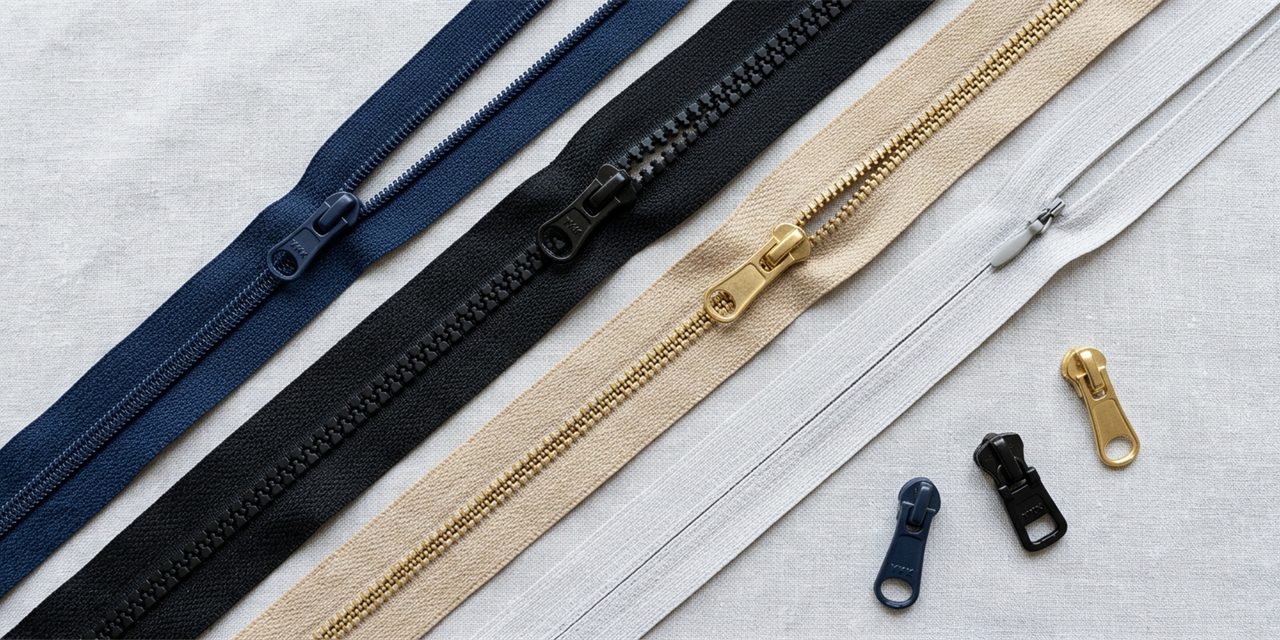
A zipper is one of the few components a customer touches every time they wear a garment. It is also one of the cheapest places to trim a few cents, and one of the fastest ways to generate a return. A zip that snags, splits or loses its puller makes a sound garment feel cheap. The fix starts with four sampling decisions: chain type, size, slider and tape. This guide covers each, plus the quality checks and spec sheet that prevent expensive surprises.
Start with the chain type
Four chain families cover most apparel and bag programmes; size and slider come afterwards.
Nylon coil: flexible all-rounder
Nylon coil is a continuous plastic filament coiled into teeth and woven into tape. It is light, flexible and tolerant of bending, making it the default for lightweight jackets, hoodies, sportswear, soft bags and linings. It dyes well, so colour matching is easier than with metal. Our nylon coil zippers cover common apparel sizes. Coil is not ideal for sharp, high-stress corners.
Moulded plastic: tough and chunky
Moulded plastic teeth are injection-moulded onto the tape, giving a wider, more rigid chain that resists abrasion and repeated washing. It belongs on outerwear, kidswear, luggage, sports bags and utility styles. Cheap teeth can turn brittle in severe cold, so winter styles should specify a cold-resistant grade. See our moulded plastic zippers.
Metal: strength with weight
Metal zippers use individual brass, aluminium or nickel-plated teeth fixed to tape. They offer high straight-pull strength and a visual weight that suits denim, workwear, leather jackets, heavy bags and premium outerwear. They are the heaviest option and the most likely to corrode if left damp. Nickel-plated metal against skin needs a nickel-release check. Browse metal zippers.
Invisible: hidden in the seam
An invisible or concealed zip is usually a fine nylon coil sewn into a seam so the teeth disappear when closed. It is the standard for dresses, skirts, bridal wear, blouses and soft tailoring. “Invisible” describes the tape and construction, not a fourth tooth material. It is light-duty by design, needs a flat seam and the correct presser foot, and is not right for a loaded waistband or reversible garment.
What zipper sizes #3, #5, #8 and #10 actually mean
The number is the approximate closed chain width in millimetres, not the zip length or a formal strength rating: #3 is fine, #5 is the apparel workhorse, #8 is heavy and #10 heavier still. Length is specified separately, usually from top stop to bottom stop. Use the number as a starting point, then match fabric weight, seam stress and frequency of use:
- #3: blouses, dresses, lightweight trousers, pockets and linings.
- #5: jackets, hoodies, trousers, skirts and light bags.
- #8: heavy outerwear, workwear, luggage and bags.
- #10: heavy coats, protective clothing and large luggage.
A larger number is not automatically stronger: tooth profile, tape and slider affect performance as much as size. At a high-stress point, size up and test the finished sample.
Sliders and pullers: the parts that fail first
The slider is the most heavily worked part of the zip; it must match chain size, tape thickness and end use.
Locking behaviour
- Auto-lock: a spring pawl engages the teeth when the pull is released. Default for centre-front jacket zips, trousers and bags, because it stops creep under tension.
- Non-lock: runs freely both ways. Suits lightweight sportswear, decorative zips and quick-access pockets, but not a zip under load.
- Pin-lock: a small pin drops into the teeth. The classic jeans slider: compact, firm and able to lock almost anywhere.
- Two-way: two sliders face each other, opening from top and bottom. Use on long coats, parkas, luggage and sleeping bags; say whether both lock.
- Reverse-slider: mounted the opposite way round, so the pull sits on the other face. Use for exposed design zips, or where a standard slider would rub a lining or skin.
Puller shape and finish
Puller shape should suit the hand: a small tear-drop for a dress, a larger ring or cord for gloves or wet hands, a reinforced pull for luggage. Finishes include brass, nickel, antique brass, gunmetal and paint; plastic pulls are lighter and colourable. For a logo, custom zipper sliders and die-cast pulls can be developed through our OEM service.
Tape, teeth finish and colour
Tape is half the zipper but often the last thing specified. It controls shrinkage, hand feel, colour and weather resistance.
Tape construction and shrinkage
Most apparel tape is polyester or cotton. Polyester resists shrinkage and mildew; cotton dyes well but can move more in the wash. Ask for the shrinkage figure for your exact wash and dry cycle, and test a sewn sample rather than a loose zip; a small rate becomes visible on a long centre-front opening. Pre-shrunk tape is available. Tape width must clear the seam allowance and stitch line.
Teeth finish and colour matching
Metal teeth come in brass, nickel, antique brass, gunmetal and painted finishes; plating and lacquer affect wear, and antique effects vary by lot. Coil and moulded teeth are dyed or pigmented, so they hold colour differently. Send Pantone TCX references for tape and teeth, say tonal or contrast, and approve the lab dip under the lighting you sell in. Metamerism can make a shop match look wrong.
Water-resistant, reflective and UV-stable options
A water-resistant zip uses coated or tightly woven tape with a water-repellent finish; it slows water but does not seal the opening, so pair it with a storm flap. Reflective tape suits workwear, cycling and kidswear, but test it after washing and abrasion. For outdoor styles, specify UV-stabilised tape and teeth and confirm they survive heat pressing or seam sealing. See the garment accessories range.
Compare the four chain types
The table is a starting point. Cost bands are relative, not quoted prices; a heavy #10 sits above a fine #3.
| Chain type | Typical size range | Strength | Cost band | Best use | Care and laundering |
|---|---|---|---|---|---|
| Nylon coil | #3–#10 | Light to medium | $–$$ | Light jackets, activewear, soft bags, linings | Cool wash; avoid high heat; check tape shrinkage |
| Moulded plastic | #5–#10 | Medium to high | $–$$ | Outerwear, kidswear, luggage, sports bags | Machine wash; avoid iron contact; check abrasion |
| Metal | #3–#10 | High | $$–$$$ | Denim, workwear, leather, premium bags | Dry promptly; salt and chlorine attack plating |
| Invisible | #2–#5 | Light | $–$$ | Dresses, skirts, bridal, blouses | Delicate wash; cool iron; avoid waistband stress |
Quality-control checks for zippers
Zipper defects are easy to miss in a folded garment, so build them into the inspection plan:
- Reciprocating test cycles: open and close the zip on a reciprocating tester for the agreed number of cycles, then inspect tooth wear, slider play, tape fraying and self-separation. Fashion styles need a short run; workwear, luggage and childrenswear need a longer one.
- Slider pull-off force: clamp the slider and pull it off the chain on a tensile tester. Record the peak force against the agreed limit; a low result points to a weak slider body or poor tooth engagement.
- Colour fastness: test wet and dry rub, wash, water and light, and grade against the grey scale. Check tape against the shell fabric as well as the teeth.
- Nickel-free and OEKO-TEX® requirements: for metal parts in prolonged skin contact, request nickel-release testing to EN 1811 where required. OEKO-TEX® documentation can be arranged on request; confirm it covers the exact article, colour and finish. If you will print “nickel-free”, agree the test and threshold with the lab first.
- AQL 2.5 final inspection: check length, shade, slider function, tooth damage, puller attachment, packing and barcode. Liberty Port’s final inspection is AQL 2.5, and export documents are prepared for every shipment.
The spec sheet you should send your supplier
A clear spec sheet shortens sampling and prevents the “same zip, different colour” problem on reorders. Include eight items:
- Item code and end use: your code, garment style and whether the zip is centre-front, pocket, sleeve or bag.
- Chain type and size: nylon coil, moulded plastic, metal or invisible, with #3, #5, #8 or #10.
- Finished length and tolerance: for example 600 mm ± 3 mm, plus closed-end, open-end or two-way.
- Tape colour and finish: Pantone TCX reference, tonal or contrast, and any water-resistant, reflective or UV-stable need.
- Slider type: auto-lock, non-lock, pin-lock, two-way or reverse-slider, and the size.
- Puller style and finish: shape, material, plating or paint, and any logo.
- Packing: pieces per polybag, inner box and export carton, plus labels and barcodes.
- Target price, quantity and delivery date: state quantity per size and colour so the quotation reflects the real order.
At development stage, add the fabric swatch and a reference garment. Liberty Port has supplied garment accessories and sewing supplies from Ningbo, China since 2013 under the A&A brand, with MOQ-friendly runs, free samples and quotes within 24 hours. Send us your spec and we will confirm what can be matched.
Frequently asked questions
What zipper size do I need for a jacket?
For most light-to-midweight jackets, a #5 nylon coil or moulded plastic zip is the practical default. Choose #8 for heavy outerwear, insulated styles or zips under frequent sideways stress. A #3 coil suits a lightweight windbreaker or lining. Test the finished sample under load.
Is a metal zipper stronger than a nylon coil?
Metal usually wins on straight tensile strength and has a premium look, which is why denim and leather use it. Nylon coil is more flexible, lighter and tolerant of bending, so it often outlasts metal on curved seams and activewear. Slider, tape and sewing matter as much as the chain.
What does a pin-lock slider do?
A pin-lock slider has a small pin that drops into the teeth when the pull is released, so the zip stays where you left it. It is the standard choice for jeans because it locks firmly and sits flat. Auto-lock sliders use a spring pawl instead.
Can you match zipper tape to a Pantone colour?
Yes. Send the Pantone TCX reference and tell us the fabric it must sit against. We will match tape and teeth as closely as the material allows and submit a lab dip or sample for approval. Exact matches vary by fibre, finish and dye lot, so approve under the lighting you sell in.