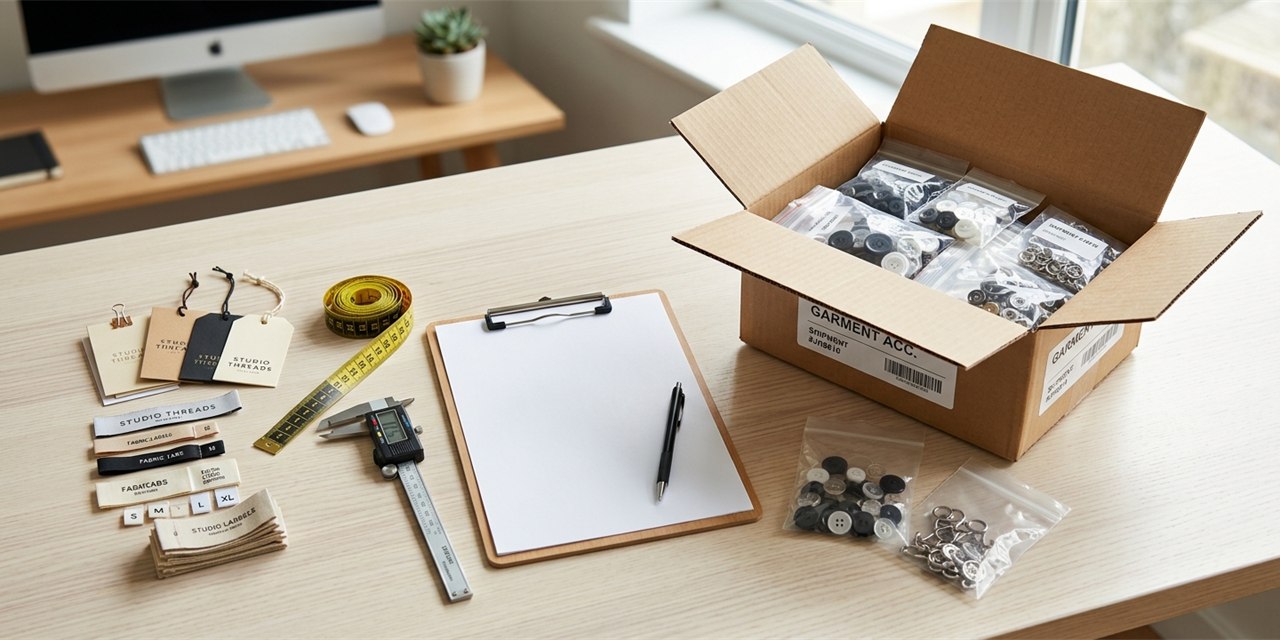
A trim order rarely fails at the sewing machine. It fails in the quotation that quoted one MOQ and delivered another, in the lab dip approved from a photograph, in the carton that reached the broker without a certificate.
All of it is a question nobody asked. The eight below work on any supplier, including us: review the garment accessories categories, then send one trim list to three factories and compare answers, not prices.
1. What is the real MOQ, per colour, per size and per custom logo?
One MOQ figure is rarely the whole story. Ask for three: per colour, per size, and per custom logo such as a printed label. Then ask whether they stack, so 500 pieces split across four colours, or multiply to 2,000. Threads and tapes add a dye-lot minimum in kilograms or metres, so drawcords and matching thread and yarn can need more material than the garments do.
What a good answer sounds like: "500 per colour, and sizes combine. The custom label has a 1,000-piece minimum because the loom setup is charged once. Your Pantone is not a stock shade, so the dye lot starts at 5 kg."
2. Can I get a free sample, and what is the sample lead time?
Free is the easy part; the calendar is where orders slip. Ask what sits between "yes" and the parcel: artwork proof, lab dip, a sample for signature, then production. Ask whether the sample comes off the production line or a bench, since a bench sample can look right where production will not, the gap an OEM development schedule closes. Courier cost sits with the buyer, so confirm who pays before dispatch.
What a good answer sounds like: "Samples are free; you pay the courier. Artwork proof in two working days, lab dip in five, physical sample in seven to ten. The sample carries the reference number that will appear on your order."
3. Which certifications can you actually produce, and for which product lines?
"Certified" and "available on request" are different products. A certified item carries a valid certificate held by the factory or its upstream mill, with a number you can check. "On request" means testing at your cost, in weeks, covering only the tested article. Ask for the number, holder, scope and expiry per line: OEKO-TEX® Standard 100, AZO-free and nickel-free reports, REACH SVHC, CPSIA for US childrenswear. OEKO-TEX® is available from Liberty Port on request, so raise it early: testing adds calendar time.
What a good answer sounds like: "The number is on the PDF, the holder is our upstream mill, the scope covers cotton and polyester woven labels, and it expires in March. Nickel-free applies to metal trims only, per batch."
4. What are your tolerances, and are they written down?
"As per industry standard" is not a tolerance. Ask for numbers in writing: cut length and width in millimetres, colour difference as Delta E against the approved dip, shrinkage after washing, and weight per piece. On woven labels the values behind most rejections are length after cutting and shade drift between dye lots. Typical bands are ±1 mm on a cut label and Delta E of 1.0, but what matters is that the final report measures them.
What a good answer sounds like: "Length ±1 mm, width ±0.5 mm, Delta E 1.0 maximum under D65, shrinkage 3% maximum after three washes at 40 °C, 2.4 g per piece ±5%. Twenty pieces per lot are measured at final inspection."
5. How do you control quality, and can I see the inspection report?
Quality control is a sequence, not a promise. Ask what happens at three points: incoming material, where thread lots and plating batches should be checked; inline, who checks the first piece; final, which AQL applies, how critical, major and minor defects are defined, and who signs the report. Liberty Port runs AQL 2.5 final inspection and issues the report with the shipment. Ask whether you can appoint a third-party inspector such as SGS or Intertek, and get photographs of packed cartons before sealing.
What a good answer sounds like: "Incoming thread is checked against the dip, the first piece and every fiftieth are checked inline, and final inspection is AQL 2.5 with zero critical defects. Third-party inspection is welcome on three days' notice."
6. What is the production lead time, and how do repeat orders work?
Split the answer into stock and custom. Stock trims ship in days; custom labels, dyed tape and moulded logos run in weeks, and the clock starts only when the deposit and the approved sample are both in hand. Ask what the lead time is measured from. Chinese New Year closes factories for one to three weeks, so a February delivery needs a November order, and a repeat only moves fast if the sample, dye lot and artwork stay on file.
What a good answer sounds like: "Stock ships in five to seven days. Custom labels take 15 to 18 working days after approval and deposit; the re-order is 12 days. We close for two weeks at Chinese New Year, so confirm the last sailing date."
7. What are the Incoterms, the packing and the documents?
Incoterms decide where your cost and risk stop. EXW leaves everything to you from the factory gate; FOB is the usual middle ground, with the supplier delivering to the named port and clearing export; CIF adds freight and insurance to your port, yet risk still passes at loading; DDP puts the whole chain, duty included, on the supplier. Packing is a specification too: polybag, inner box, carton dimensions, and marks carrying your PO number and carton count. The document set is certificate of origin, packing list, commercial invoice and inspection report.
What a good answer sounds like: "FOB Ningbo, 500 pieces per polybag, 20 bags per carton at 18 kg gross, marks per your artwork. CO, packing list, invoice and inspection report are scanned 48 hours before the vessel closes."
8. What happens if the goods are wrong?
Every supplier says they will solve it. Ask for the mechanism. If final inspection lands above the agreed AQL, is the lot reworked, replaced or credited? If goods arrive short or wrong, who pays the return freight? What is the claim window, and does it start at delivery or at unpacking? A window shorter than your QC turnaround is a trap, and a small shortfall is not worth a dispute if it is credited against the next invoice.
What a good answer sounds like: "Above AQL 2.5 we rework and re-inspect at our cost. Claims within 14 days with photos and the carton number: replacement above 2% defects, credit note for shortfall, freight ours when we shipped the wrong item."
Score the answers on one page
Comparing three suppliers who reply in three formats is hard, so the table below scores each on the eight criteria, from 1 (evasive) to 5 (specific and verifiable).
| Area | What earns a 5 | Score (1–5) |
|---|---|---|
| MOQ | MOQ flexibility. Per colour, size and logo minimums, stacking in writing | |
| Samples | Sample speed. Dated steps, courier cost agreed upfront | |
| Certification | Certification depth. Number, holder, scope and expiry | |
| Tolerances | Tolerance discipline. Length, width, Delta E, shrinkage stated | |
| QC | QC transparency. AQL 2.5, three checkpoints, third-party access | |
| Lead time | Lead-time reliability. Clock starts at a named event | |
| Documents | Documentation. Incoterm, packing, marks, CO, invoice | |
| Claims | Claim handling. Rework, credit path, freight and claim window | |
| Total | Total out of 40. 32 or more, start small; below 24, keep looking | ____ / 40 |
Red flags that end the conversation
Some answers are not weak, they are disqualifying:
- Refusal to name the factory. A trading company is fine; one that will not name the maker or the location is a quality risk.
- A quote 40% below the market. Trims are material plus labour, so a price that far under means thinner substrate or cheaper plating.
- No lab dip. Colour approved from a screen will be someone's interpretation of your Pantone, not your Pantone.
- "All certifications available" with no certificate number. Every real certificate has a holder, a scope and an expiry.
- Pressure to pay 100% upfront. Full prepayment on a first order removes every incentive to fix a problem.
Payment terms: what is normal
Thirty per cent deposit by T/T against the order confirmation and seventy per cent against the bill of lading copy is the standard structure: the deposit buys materials, the balance is released once the goods are on the water. An L/C at sight suits larger orders and moves the guarantee to the banks; Trade Assurance, holding payment until delivery terms are met, is a sensible middle option. Either way, keep the first order small: one style, a quantity you can inspect properly.
Liberty Port has exported garment accessories and sewing supplies from Ningbo since 2013 under the A&A brand, and the about page is the short version. To test these questions on a live quotation, send a trim list through the contact page.
Frequently asked questions
What is a realistic MOQ for custom garment accessories?
Expect a minimum per colour, not per style, and a separate minimum for any custom logo or surface treatment. Threads and tapes add a dye-lot minimum in kilograms or metres. Ask whether minimums stack across colours or multiply, because that answer changes the order value more than price.
Should the first order be small?
Yes. A first order is a paid trial of the supplier's communication, tolerance control and documentation, not just the product. Keep it to one or two styles you can inspect thoroughly, then scale once the report, packing and carton marks match what was promised.
Which certification matters most for trims?
For anything that touches skin, OEKO-TEX® Standard 100 is the certificate buyers ask for first, backed by AZO-free and nickel-free reports depending on the material. The distinction that matters is a verifiable certificate number versus a claim of certification on request.
Who pays for samples and courier costs?
Most suppliers, including Liberty Port, send samples free and ask the buyer to cover courier charges, which keeps sampling fast and avoids paperwork. Confirm who pays before dispatch, charge the courier account, and request the tracking number when the parcel leaves.