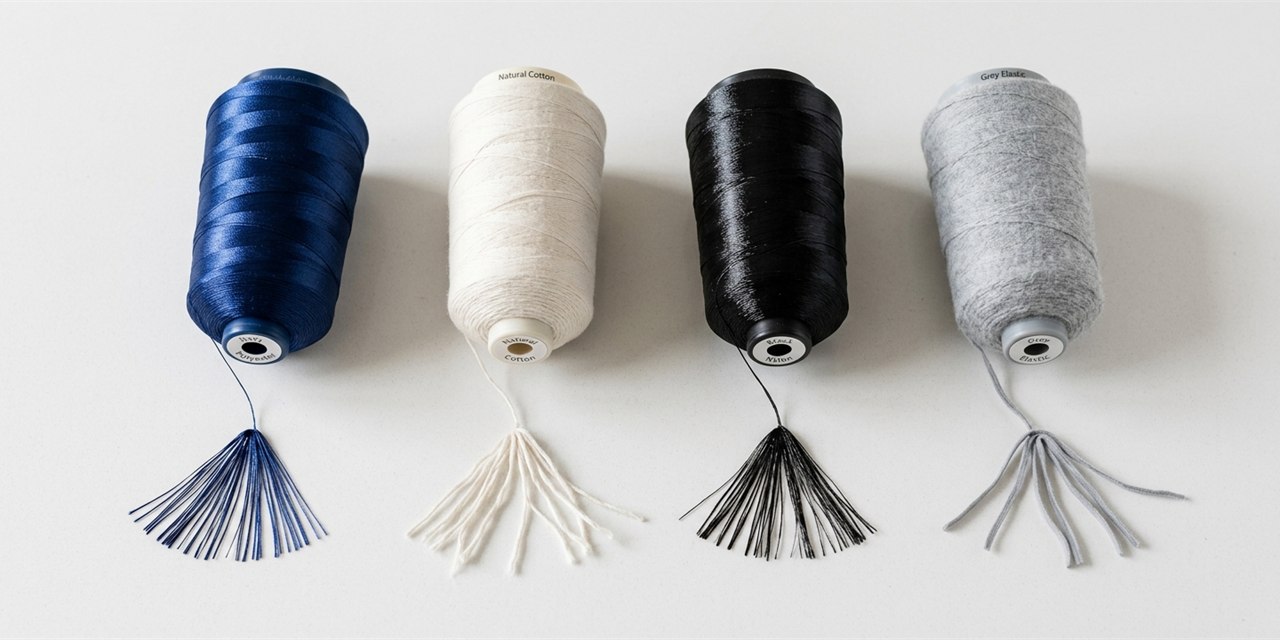
Sewing thread is the cheapest component in a garment, and a frequent cause of a failed seam. A 40/2 polyester cone and a 40/2 cotton cone look identical under factory light yet behave differently at the needle. This guide decodes the cone, compares the four families factories buy, and sets out a specification to send to suppliers. The range sits in thread and yarn and garment accessories.
How sewing thread is numbered
Every cone carries a ticket number: 20/2, 40/2, 60/3, 80/3, 120/2. The first number is the size, the second is the ply count: the number of single yarns twisted together. A 60/3 is a fine three-ply that survives high-speed overlocking; a 20/2 is a thick two-ply for buttonholes.
A bigger first number means a finer thread. Ticket numbering inherited cotton yarn counting, which measures length per unit of weight: a finer yarn runs further and earns a higher number. Ticket 80 is far finer than 20.
Tex and metric count in plain terms
Ticket numbers are nominal and drift between mills, so technical buyers quote Tex too. One Tex unit is one gram per 1,000 metres, so Tex 30 weighs 30 g per kilometre. Unlike ticket, Tex rises as the thread gets thicker.
Metric count (Nm) behaves like ticket numbers: Nm 50 means fifty 1,000-metre lengths weigh one kilogram. Tex is roughly 1,000 ÷ Nm, or 590 ÷ English cotton count (Ne), so Nm 40 is about Tex 25. Quote both: two suppliers' 40/2 can differ by a few Tex.
Polyester: the default fibre
Polyester covers most garment sewing: strong, colour-fast, cheap and dimensionally stable, so it neither shrinks nor fades much in the wash. Construction matters as much as fibre.
Spun polyester
Short staple, spun and twisted like cotton. Matte, slightly hairy, softer and more extensible than filament, so it suits jersey, interlock and seams that must move. Cheapest and weakest of the three, and it lints the needle plate.
Filament polyester
Continuous filaments, twisted or intermingled: high tenacity, low friction, high lustre, almost no stretch. Correct for topstitching, denim, bags and leather goods, but too stiff for stretch seams, where it grins or snaps.
Core-spun polyester
A filament core in a staple sheath, usually cotton: filament strength with a matte surface, and the sheath shields the core from needle heat. Standard for denim, workwear, shirting and high-speed sewing.
Cotton: heat tolerance, matte finish
Cotton is weaker and less elastic, and it can shrink and lose colour faster than polyester, but it takes heat and suits natural-fibre garments.
Spun cotton
Two or three plies; standard for cotton and linen wovens, quilting, hand finishing and garment-dyed styles where polyester reads as shine. Cotton shrinks unless pre-shrunk, so a cotton thread can pucker a sanforised shirt seam.
Mercerised cotton
Caustic treatment swells and straightens the fibre, raising lustre, strength and dye uptake. Used for topstitching, embroidery and decorative work.
Glazed cotton
Starched, waxed or polished, which lowers friction for hand-sewing and tailoring; hot washing strips the glaze.
Nylon and elastic threads
Bonded nylon
Bonded filaments cannot fray at a cut end; the thread offers very high strength and abrasion resistance with moderate stretch. Standard for leather goods, luggage, outdoor gear and denim buttonholes. Heat and light are its limits; a hot iron flattens the bond.
Textured nylon
Bulked for stretch and cover; softer than bonded, for swimwear, lingerie and overlocked seams that must extend.
Elastic and woolly nylon
An elastomeric core in a nylon wrap, with high stretch and quick recovery, for overlocked knit edges, lingerie and gathering. Sew with low tension, never press it, and keep it out of hot storage.
The four fibres side by side
The table below sets the properties that decide a specification; cost bands are relative.
| Property | Polyester | Cotton | Nylon | Elastic / woolly nylon |
|---|---|---|---|---|
| Tenacity / strength | High; highest in filament | Low; stronger when wet | Very high, excellent abrasion resistance | Low; the value is stretch |
| Elongation | Low in filament, moderate in spun | Low | High, with good recovery | Very high |
| Heat / ironing tolerance | Moderate; glazes under a hot iron | High; takes a hot cotton setting | Low; cool synthetic setting | Very low; never press |
| Laundering / bleach | Excellent; resists dilute bleach | Good; strong bleach weakens it | Good; chlorine yellows it, UV degrades it | Good, but heat cuts recovery |
| Cost band | $ | $$; mercerised $$$ | $$ to $$$ | $$ |
| Typical uses | Seaming, overlocking, knits, topstitching | Wovens, quilting, embroidery, garment dye | Leather, luggage, buttonholes, bar-tacks | Knit edges, lingerie, swimwear, gathering |
Matching thread to fabric and seam
Fibre is half the decision; the seam is the other half. Too heavy a thread pulls the cloth, too fine a thread shreds.
- Silk, chiffon and georgette: fine filament polyester or mercerised cotton, ticket 80/3 to 120/2, size 9 to 11 needle, short stitch, low tension.
- Denim and heavy chain stitch: ticket 30/2 or 20/2 core-spun or filament polyester; a chain stitch needs low elongation so the loop forms cleanly.
- Knits: spun polyester in the seam and textured or woolly nylon in the loopers, with seam elongation matched to the fabric.
- Overlock and serger: 40/2 or 60/3 in the needles, finer thread or woolly nylon in the loopers, so the seam sits flat and stretches.
- Buttonholing: 20/2 to 30/2 cotton or core-spun for a raised cord, bonded nylon for denim.
- Topstitching: 30/2 or 20/2 filament polyester for lustre and abrasion resistance, mercerised cotton for matte work.
- Embroidery: 40-weight (40/2) on top with 60/2 to 80/2 bobbin thread, keeping the back soft.
Shade matching: Pantone TCX, dye lots and lab dips
Thread is dyed on a different substrate from the shell, so a Pantone TCX code is a starting point, not a guarantee: it reads cooler on filament polyester and warmer on cotton. Send the code with the fabric swatch and say which wins if they disagree.
Dye lots drift, so keep the original lot number on file and never approve a shade from a photo. Approve a physical lab dip under D65, sign and date it, and treat it as the standard. Where thread sits beside other trims, submit dips together so ribbon and tape shades are approved against it.
Sustainability and compliance
Compliance questions arrive late, usually after care-label artwork is approved. Ask earlier, and ask for documents rather than claims.
- OEKO-TEX® Standard 100 on request: ask for the certificate number, confirm the scope covers thread and your colour, and request lab reports naming the test method.
- AZO-free dyes: required for the EU under REACH aromatic amine limits; a dated dye declaration naming the colour range suffices.
- Nickel-free trims: applies to buttons, snaps, zip sliders and eyelets, so specify it across the trim pack.
- Care labels: wash and iron symbols must suit the thread, not just the shell; a hot cotton iron is wrong for a polyester seam, and cotton-safe bleach yellows nylon.
The thread spec sheet: what to send
Most thread problems are specification problems, and one page prevents them. Send these eight lines for a quote in 24 hours and free samples.
- Fibre and construction: spun, filament or core-spun polyester; mercerised or glazed cotton; bonded or textured nylon; elastic.
- Ticket number and ply: 40/2, 60/3, plus Tex if the file carries it.
- Shade reference: Pantone TCX code, a physical swatch or the previous dye lot.
- Length per cone: for example 5,000 m, in metres or yards.
- Cone weight and type: grams per cone, and the cone format the machine pin accepts.
- Sewing application: seam type, needle size, machine speed and the fabric.
- Certifications required: OEKO-TEX® Standard 100, AZO-free declaration or the brand's own list.
- Packing: cones per box, cartons per pallet, shipping marks.
Send the whole bill of materials and consolidate it under one OEM programme: one inspection, one shipment.
Quality checks before you approve a lot
Five checks catch most thread problems, all on a sample seam.
- Seam strength: pull a sewn seam apart and note where it fails; thread breaking before the fabric means it is too weak or the needle too small.
- Seam elongation: stretch the seam along the fabric's dominant direction; a knit seam should extend and recover, not crack or grin.
- Abrasion: rub the stitched seam. Matted, hairy thread fails faster than filament, which is why heavy-wear seams use filament or core-spun.
- Colour fastness: wash a sewn swatch, then rub a dry and a wet white cloth along the stitch line; bleed onto the shell is a claim waiting to happen.
- Needle heat damage: run a long, fast pass on the real machine; glazing, snapping or a stiff bead means slower speed, a larger needle or core-spun.
We inspect to AQL 2.5 and ship export documents with every order; the lines behind these checks are in the thread and yarn range. Send your spec via the contact page for samples and certificates.
Frequently asked questions
What does 40/2 mean on a sewing thread cone?
Ticket 40 is the size number and 2 is the ply count, so 40/2 is a medium two-ply thread made by twisting two single yarns together. It is the all-purpose weight for woven and knit apparel, overlocking and general seaming. Ask for its Tex value as well, because ticket numbers are nominal and vary slightly between mills.
Is polyester thread stronger than cotton thread?
Yes. Polyester has higher tenacity than cotton in every construction, and filament or core-spun polyester is stronger still. Cotton compensates with heat tolerance, a matte finish and better performance in garment dyeing. Choose polyester for seam strength and wash durability; choose cotton where the thread must survive a hot iron or take the same dye as a natural-fibre shell.
Which thread should I use for knits and overlocking?
Use spun polyester in the needle threads and textured or woolly nylon in the overlock loopers, so the seam extends with the fabric and still recovers. Match the seam elongation to the fabric rather than exceeding it, keep the looper tension low, and avoid stiff filament thread, which cracks on the stitch line when the knit stretches.
How do I match sewing thread to a Pantone TCX shade?
Send the TCX code with the actual fabric swatch, then approve a physical lab dip under D65 lighting rather than a photograph. Thread is dyed on a different substrate from the shell, so the match will be close, not identical. Record the approved dip and the dye lot number for repeat orders.